Browser storage settings

Advertising and analytics are off. Read about browser storage and your choices in our privacy notice.

Read our privacy and cookie notice
WSI Trash & Recycling Valet
Request a proposal

Pointer settings

Choose a WSI cursor or your device’s default.

A brief ring confirms a mouse click. Animations respect your device’s reduced-motion setting. Touch and text-entry controls keep their familiar behavior.

High-contrast mode uses your system cursor. Keyboard focus stays visible with effects on or off.

How a service
night works.

Our porters collect at residents’ doors, manage waste-area capacity, and report concerns to your community team.

Service night
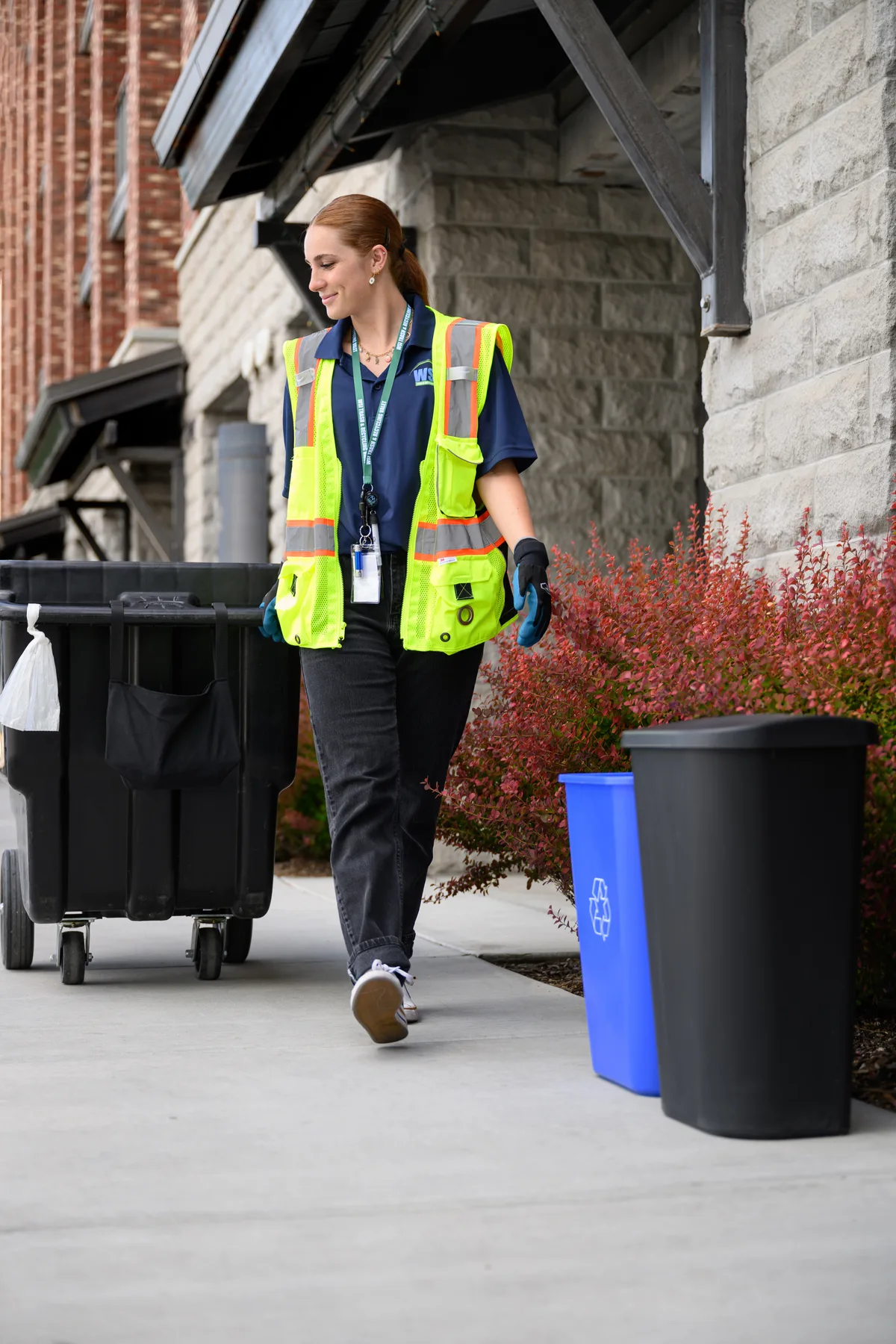
A WSI porter with a black tilt truck beside residents' trash and recycling bins at an apartment community
A WSI porter on a community collection route.

The work
on a service night.

  1. 01

    Staff the route.

    A dedicated porter, training, and a structured coverage plan.

  2. 02

    Collect and distribute.

    Doorstep collection continues at the community’s waste areas.

  3. 03

    Record and review.

    Service-quality reviews and recorded concerns guide the next action.

Same containers.
Better use of space.

Porters spread bagged trash across every approved trash container in the collection area, instead of piling it into the closest one.

Container example
Trash lids closed
2 of 3
Bags left outside
2
Recycling
Kept separate
One overloaded container causes problems while another has room.Load balancing uses approved capacity for the same waste stream instead of overloading one location.Trash distributed across every container.Collected trash is distributed across approved trash containers. Recycling stays separate.

Designated compactors

Trained, authorized porters follow manufacturer and property procedures. Equipment faults and blockages are reported.

Recurring overflow

When a waste area overflows again and again, it moves through the same pipeline until capacity matches demand.

  1. ObserveWaste areas + requested Photo Watch records
  2. CoordinateYour team + waste hauler
  3. ReviewPickup frequency + capacity

Service plan adjusted to fit the waste area

Follow your waste areas with Photo Watch

Porter training
& backup coverage.

A dedicated porter serves your community, with trained staff available to cover absences and emergencies.

A dedicated WSI porter.

Your porter learns your community’s layout, collection route, and service requirements. That familiarity builds continuity and accountability, night after night.

Background-checked WSI associates

Every porter is an associate, not a contractor or subcontractor.

Training before the first shift.

Multiple days of training and orientation cover service procedures, Fair Housing basics, and communication with residents.

Quality is part of the training from day one.

Six layers
of coverage.

Six deep, every service night. If your porter can’t make it, the next person in line covers the route that night.

0missed service nights
since July 1, 2024

Six layers of coverageEvery service night
A member of WSI leadership
A regional manager with a tablet
A district manager holding a phone
A field resource supervisor with a clipboard
A field service technician with a flashlight
A WSI valet porter holding a tied trash bag
  1. Valet porters assigned to your property

    Your dedicated porter serves your community night after night and knows its layout and routines.

    Every service night
  2. Field service technicians, floaters & subs

    Trained WSI associates who step in when a porter is out, so the route still runs that night.

  3. Field resource supervisors

    Supervisors who support routes across a group of communities and can cover service themselves.

  4. District managers

    Managers responsible for service across a district, ready to staff or cover a route.

  5. Regional manager

    Oversees service across the region and makes sure every route in it is covered.

  6. Other staff, leadership, management & ownership

    The rest of the WSI team, up to ownership, stands behind every service night.

Service quality audits.
At least quarterly.

Completed service is checked at every community, at least once per quarter.

  1. Q1Quality review
  2. Q2Quality review
  3. Q3Quality review
  4. Q4Quality review

Need a closer look? Request an additional audit when a concern arises.